Queer Places:
University of Oxford, Oxford, Oxfordshire OX1 3PA
St Andrew Churchyard, B5285, Coniston LA21 8EN, United Kingdom
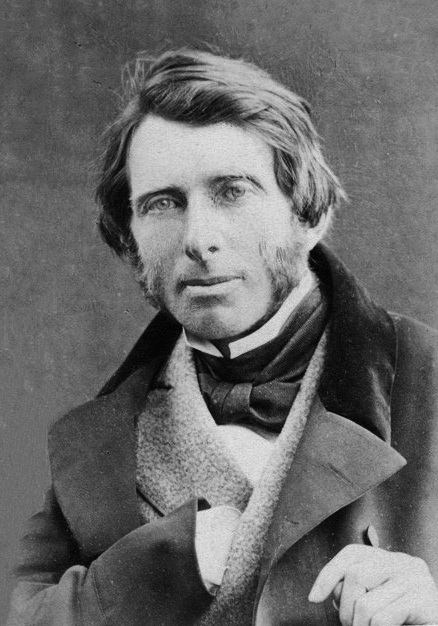 John Ruskin (February 8, 1819 – January 20, 1900) was the leading English art critic, social thinker, and polymath of the Victorian era. His prolific writings on art,
architecture, geology, and political economy profoundly shaped the Pre-Raphaelite movement, inspired the Arts and Crafts movement, and laid groundwork for modern ecology and
democratic socialism.
John Ruskin (February 8, 1819 – January 20, 1900) was the leading English art critic, social thinker, and polymath of the Victorian era. His prolific writings on art,
architecture, geology, and political economy profoundly shaped the Pre-Raphaelite movement, inspired the Arts and Crafts movement, and laid groundwork for modern ecology and
democratic socialism.
His personal life, however, remains one of the most intensely analyzed and debated subjects in 19th-century cultural history, particularly regarding his sexuality,
non-normative desires, and queer themes within his circles.
Born in London to wealthy, deeply evangelical parents. Educated largely at home and at Christ Church, Oxford, he won the Newdigate Prize for poetry in 1839. His early
travels across Europe fostered an intense devotion to nature and Gothic architecture.
In 1843 he published Modern Painters (Vol. I, 1843) to defend J.M.W. Turner, followed by The Seven Lamps of Architecture (1849) and The Stones of Venice (1851–53). He
became the primary defender and mentor of the Pre-Raphaelite Brotherhood (including John Everett Millais and
Dante Gabriel Rossetti).
He married Euphemia "Effie" Gray in 1848. After six years, the marriage remained unconsummated. Effie successfully sued for annulment in 1854 on grounds of "incurable
impotency" / non-consummation, later marrying Millais.
In 1860 he turned toward radical social and political critique with Unto This Last (1860). Appointed the first Slade Professor of Fine Art at Oxford in 1869. Founded the
Guild of St. George and promoted industrial craft reform.
In 1880 he suffered recurring bouts of severe mental breakdown. Retreated to his estate, Brantwood, in the Lake District, writing his autobiography Praeterita (1885–89)
before spending his final decade in near-total silence. Passed away on January 20, 1900.
While Ruskin did not explicitly identify as homosexual or queer—terms that did not exist in their modern sense during his youth—his non-conformity to Victorian
heterosexual standards, his unconventional attachments, and his broader influence on queer aesthetic movements have made him a central figure in 19th-century LGBTQ history
and queer theory.
The annulment of his marriage to Effie Gray sparked widespread speculation about his sexuality.
A persistent 20th-century myth claimed Ruskin was repulsed by female pubic hair because he was accustomed only to smooth classical statues. Modern historians reject this
simplified trope, pointing out that Ruskin was familiar with naked female models and life drawing.
Many scholars view Ruskin through a modern asexual spectrum framework. He prioritized intellectual companionability, intense romantic idealization, and spiritual
communion over physical intimacy.
Ruskin's later obsession with young girls—most notably Rose La Touche, whom he met when she was 10 and proposed to when she turned 18—has led critics to analyze his
eroticization of pre-pubescent innocence. Like his contemporary Lewis Carroll, Ruskin was intensely drawn to an idealized,
non-sexual state of youth.
Despite his personal prudery and rigid moral framework, Ruskin’s aesthetic theory served as a foundation for late-Victorian queer culture:
At Oxford, Ruskin taught Oscar Wilde, Walter Pater, and
John Addington Symonds (a pioneer of early homosexual rights literature).
Ruskin's insistence on worshiping physical and artistic beauty—liberated from utilitarian capitalism—was directly adopted by Wilde and the Decadent Movement to construct
a distinctively queer, aesthetic lifestyle outside middle-class norms.
Ruskin had a profound effect on Marcel Proust, who spent years translating Ruskin's work (The Bible of Amiens, Sesame and
Lilies) into French. Queer theorists often note how Proust’s engagement with Ruskin helped shape his ideas on memory, perception, homoerotic artistic appreciation, and fluid
temporality.
References:
Other references:
- Hilton, Tim. John Ruskin: The Early Years (1985) and John Ruskin: The Later Years (2000). Yale University Press.
- Lutyens, Mary. The Ruskins and the Grays (1969) and Millais and the Ruskins (1967). John Murray.
- Batchelor, John. John Ruskin: A Life (2000). Carroll & Graf.
- Burd, Van Akin (Ed.). John Ruskin and Rose La Touche: Her Diaries and Letters (1979). Oxford University Press.
- Dellamora, Richard. Masculine Desire: The Sexual Politics of Victorian Aestheticism (1990). University of North Carolina Press.
- Proust, Marcel. On Reading Ruskin (Transl. Jean Autret, William Burford, and Phillip J. Wolfe, 1987). Yale University Press.
- Ruskin, John. Praeterita: Outlines of Scenes and Thoughts Perhaps Worthy of Memory in My Past Life (1885–1889).
Support this project
This website is a passion project researched, developed, and funded entirely by me. If you find the content valuable and would like to help support the ongoing research and hosting costs, any contribution is deeply appreciated.
Thank you for keeping this independent resource alive!
My books on Amazon: Elisa Rolle's books
BACK TO HOME PAGE
